
What Is Actually Happening Under the Needle?
Santa Barbara Health & Healing Center
The Question Patients Are Really Asking
Patients often ask what the needle is actually doing — in the tissue, in the nervous system, in the whole person.
Some ask about dopamine. Some ask about the vagus nerve. Most are really asking a simpler version of the same thing:
What is physically happening when a needle goes in?
The answer can be described in more than one language.
In Chinese medicine, we might speak of Qi moving and rebalancing.
Here, we’ll look at the same process through the lens of physiology.
It is mechanical. Biochemical. Networked.Step One: Mechanical Signaling
When a needle is inserted and gently rotated, the surrounding connective tissue does not remain passive.
Fascia winds slightly around the shaft. Collagen fibers shift. Fibroblasts — the structural cells embedded in that matrix — deform in response to the change in tension.
This is called mechanotransduction: the process by which cells convert physical force into intracellular signaling.¹
In some experimental models, sustained mechanical deformation of connective tissue cells has been shown to influence gene expression related to inflammation and extracellular matrix remodeling.² These changes appear subtle and cumulative — more like tissue adaptation than a dramatic genetic shift.
Nothing dramatic is visible from the outside.
But at the microscopic level, the tissue is responding.
Step Two: ATP Release and Adenosine Formation
Mechanical stimulation prompts local cells to release ATP (adenosine triphosphate) into the extracellular space.
Outside the cell, ATP acts as a signaling molecule. It is rapidly broken down into adenosine.
Adenosine binds to A1 receptors on nearby sensory nerve endings.
That binding reduces nociceptive firing and produces localized inhibitory effects.³
This remains one of the clearest mechanistic findings in acupuncture research.
The needle does not inject a substance.
It encourages tissue to release its own regulatory molecules.
Step Three: Ascending Signals
The process does not stop locally.
Sensory fibers activated at the needle site carry signals toward the spinal cord and brainstem.
Structures such as the nucleus tractus solitarius and dorsal vagal complex integrate that input and influence autonomic output.⁴
From there, downstream effects may shape:
Heart rate variability
Muscle tone
Inflammatory signaling
Limbic activity
The stimulus begins in a small patch of tissue.
The integration unfolds across systems.
In classical language, this coordinated movement might be described as the flow of Qi through channels. In contemporary physiology, it is signaling through connective tissue, neural pathways, and autonomic networks.
The vocabulary differs, but the body does not.
If You Could Shrink Down and Watch
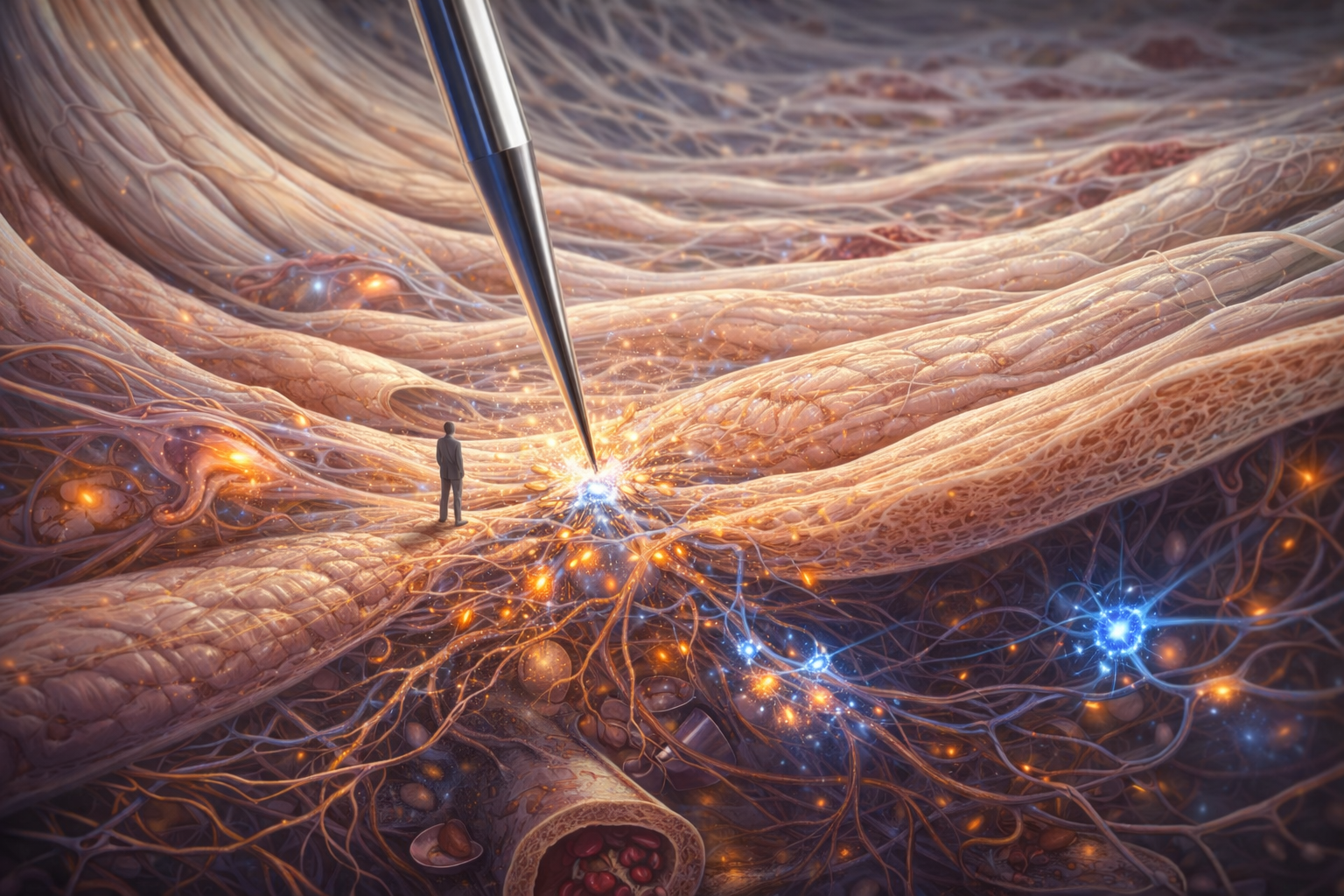
Imagine shrinking small enough to stand inside the connective tissue of the forearm at PC6.
At first, nothing remarkable happens.
The needle rotates gently. Fascia responds — not with light or heat, but with subtle torsion. Collagen fibers wind slightly, then settle into a new alignment.
Fibroblasts deform.
A small amount of ATP enters the extracellular space. It is not an alarm. It is a signal.
Enzymes convert ATP into adenosine. Concentrations rise within a radius of a few millimeters.
Nearby nerve endings detect the shift.
A1 receptors bind.
Firing decreases.
Upstream, signals travel toward the spinal cord. Toward the brainstem. Toward structures that regulate breathing, heart rate, and vigilance.
Nothing flashes.
Nothing explodes.
But if you widened your view, you might notice something subtle:
Breathing deepens.
The shoulders settle.
The jaw releases.
In one framework, this might be described as Qi beginning to move more freely.
In another, it is physiology recalibrating tone.
Either way, something has shifted.
Where Acetylcholine Fits
Acupuncture also appears to engage cholinergic pathways, particularly through vagal mechanisms.
Acetylcholine plays a central role in parasympathetic signaling and in what is known as the cholinergic anti-inflammatory pathway.⁵
Through brainstem autonomic centers, vagal output can influence immune cell behavior and inflammatory signaling.
Some preclinical studies suggest acupuncture may influence acetylcholine signaling or acetylcholinesterase activity in inflammatory states.⁶
This is not a dramatic surge.
It is a shift in tone — an adjustment in regulatory bias.
Why This Matters
Understanding the mechanism does not replace traditional language.
It gives us another way to describe what experienced clinicians have long observed.
A thin piece of stainless steel deforms connective tissue, initiates biochemical signaling, activates afferent fibers, and engages autonomic networks.
A small input can influence a large system.
Call it regulation.
Call it the movement of Qi.
The important point is this:
The body responds.